
Creative Fatigue: How Often Should You Change Ad Creatives?
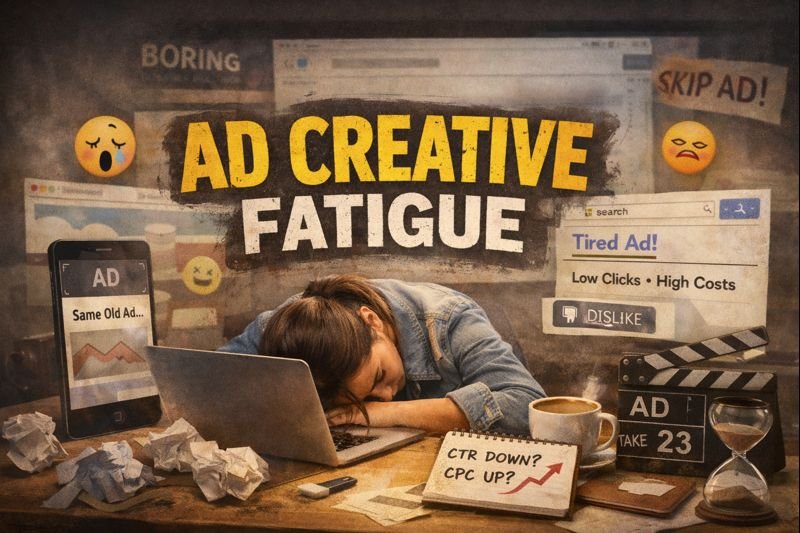
You put up an ad, and it performs well. It clicks, and the conversions are looking good, and then slowly, almost quietly, it all just stops. Nothing else has changed. The targeting is the same. The budget is the same. But the results just aren’t there anymore.
This is where ad creative fatigue shows up.
It’s one of those problems that marketers face all the time but never really discuss. Most people only realize it after they’ve wasted money on it. Knowing how ad creative fatigue works and how often you need to refresh your creatives can save your performance and your sanity.
Why Ad Creative Fatigue Occurs (And Why It’s Okay)
Ultimately, ad creative fatigue is just human behaviour. It’s not that you don’t like the brand, but you’re ignoring the ad. It’s because your brain has already processed that message and determined that it’s no longer necessary.
When you show a person the same ad multiple times, the message is no longer new. The images are no longer exciting. Even the best offer is less desirable when it becomes predictable. This is exactly how ad creative fatigue happens.
Social platforms accelerate this problem. Algorithms are designed to show winning ads more often, which increases frequency. Higher frequency means faster burnout. So ironically, the better your ad performs early on, the quicker ad creative fatigue can creep in.
You’ll usually see it in the numbers before you feel it emotionally. Click-through rates dip first. Then the cost per click slowly rises. Eventually, the conversions dwindle, and you’re left scratching your head, wondering what happened. In most instances, the strategy itself wasn’t flawed; the creative just wore out.
The important thing to keep in mind is this: ad creative fatigue is not an error; it’s a cycle. Every ad has a shelf life. The objective isn’t to experience fatigue but to mitigate it before it hurts performance.
How Often You Actually Need to Change Ad Creatives
There is no hard and fast rule, but there is a trend. The speed of ad creative fatigue is determined by the number of times users view your ad and the size of your audience.
In a social media platform like Instagram, Facebook, or TikTok, ad creatives will fatigue faster. Users are scrolling through quickly, and their attention span is short. For a cold audience, ad creative fatigue may appear in as little as one to two weeks. For a warm audience, you may have a little extra time, but even then, the ad performance will not remain strong past a month without some sort of refresh.
Display and video ads tend to run for a longer period, but they are not exempt either. Even YouTube ads can suffer from ad creative fatigue when the audience recognises the first few seconds and tunes out. Search ads are less prone to it, but the visual assets, headlines, and descriptions tend to lose their effectiveness when the audience sees them repeatedly.
The worst thing that can happen to advertisers is waiting for the performance to drop before doing anything about it. When ad creative fatigue becomes apparent, the algorithm has already penalised your ad relevance, and it becomes more difficult and costly to recover.
A smarter approach is proactive rotation. Instead of asking, “Is this ad dead yet?”, the better question is, “Has this ad been shown long enough to start feeling familiar?” Familiarity is the first step toward ad creative fatigue.
How to Beat Ad Creative Fatigue Without Starting From Scratch
The good news is that fighting ad creative fatigue doesn’t mean redesigning everything every time. In fact, small creative tweaks are often more effective than complete makeovers.
Often, it’s not the deal that’s stale, it’s the communication of the message. A change of hook, a different visual, a different opening line can quickly refresh attention. Even small tweaks can help delay ad creative fatigue and extend the life of an ad.
Another strategy that works well is creative variety. When you are dependent on a single successful ad, the ad creative fatigue rate accelerates because all the delivery pressure is on a single asset. Having multiple creatives running at the same time helps distribute the exposure and ensures that the audience is not seeing the same thing over and over again.
Another strategy that would work in this scenario is user-generated content. UGC is much more like real-life experience than advertising and thus helps prevent ad creative fatigue.
It’s also important to learn when the fatigue of ad creatives is actually an indicator of success. Sometimes the fatigue of ad creatives simply means that you have reached everyone who was ready to take action. At this point, it won’t be enough to simply refresh the ad creatives.
Final Thoughts
Ad creative fatigue isn’t a warning sign that you’re bad at advertising. It’s a sign that your ads are being viewed. The brands that are always winning aren’t the ones trying to get the perfect creative; they’re the ones who are planning for fatigue before it happens.
If you look at refreshing your creativity as something you do on a regular basis and not something you do when you’re in a panic, your campaigns will stay healthier for a longer period of time. You have to pay attention to what’s going on and refresh your creativity based on that, remembering that advertising is a conversation, not a press release.
Once you understand the concept of ad creative fatigue, you can move from a panic mode to a scaling mode.